
What we inherit
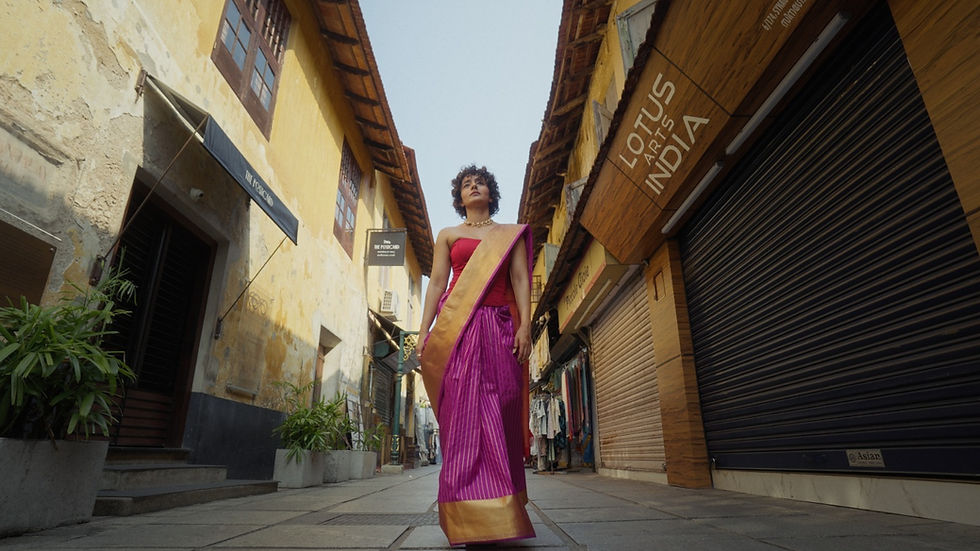
There are some sounds you grow up playing somewhere in the house, folded into childhood, carried in through a grandmother’s voice, becoming part of the background before you know to call them yours. For Kavya Ajit, Carnatic music was one of those sounds. It took years of moving through other music, other places and other versions of herself for her to turn around and realise what had been sitting there all along. Today, she finds herself returning to it, not quite as the child who once learnt it, but as a musician with her own questions about what tradition can become — a 19th-century thillana meeting funk, a pattu saree against the streets of Fort Kochi, a Western violin alongside a Carnatic voice. Perhaps coming home to something is less about going back to where you began, and more about finally hearing it for yourself.
A: There’s something beautiful about having to lose your way before finding your way home. Does that feel true of your relationship with Carnatic music?
K: It is true when they say that sometimes you have to lose something to understand its value and beauty truly. And that is very true in my case. I grew up in a household where Carnatic music surrounded me. It was an obvious and natural part of my upbringing that I never really valued at that time. It was as simple as an everyday habit.
As I grew older, I spent several years exploring different styles and genres of music, while Carnatic music gradually took a backseat. And I believe it was that distance that made me realise what I had been missing out on all along — the depth, beauty and richness of the music I had grown up with. And it is that realisation that ultimately led me back to my roots.
A: Some inheritances are less tangible than others. Your grandmother, childhood, a raga. How much of yours lives in the music you make today?
K: Considering the fact that I am a lot more into Carnatic music at this point than I used to be during the initial years of my musical career, I think every bit of my childhood and my grandmother lives in the music that I make today. My exposure to music as a kid and my grandmother’s lessons, vocal tips and techniques are what guide me today as a musician who has found her way back to her roots after a long and winding detour.

A: There is a particular kind of nostalgia attached to Kerala, especially for those who grew up there. Does your music carry yours?
K: I wouldn’t necessarily say that my music does, but the musician in me certainly does. I was born and brought up in Kerala and lived there until I completed my twelfth standard, before moving out for college and higher studies. So Kerala has had a profound influence on me: not just its music, but its people, culture, traditions and way of life. All of these have played a huge role in shaping both the musician and the person I am today. I owe a great deal to Kerala and its people for who I am and for the person I have become today.
A: Between the Carnatic vocalist and the Western violinist, has there ever really been a need to choose?
To be honest, I think I’ve always had a stronger inclination towards singing than playing the violin. Perhaps that’s because I started learning vocals when I was just four, whereas the violin became a part of my musical journey a little later.
It is not just that. Whenever I perform live, I feel a deeper connection with the audience when I sing than when I play the violin. Using my voice kind of allows me to communicate and express myself more freely and directly. So, for me, it has always been singing first, and then the violin.
A: What is the one ritual that finds you every time you sit to practise?
K: I wouldn’t exactly call it a ritual, but there’s a very strange realisation that hits me every time I sit down to practise. It’s the realisation that the one thing that gives me the deepest sense of peace and happiness is simply being able to find the time to sing — to sing my heart out, work on my skills, try to get better, and feel myself growing with each passing day. Nothing gives me more contentment than a good practice session. It’s not money, it’s not fame, and it’s certainly not social media numbers. Sometimes, all I need is a few quiet minutes to myself, to practise and sing just for me.

A: Tradition is often spoken about as something to preserve. You seem more interested in letting it evolve. Is there a line you wouldn’t cross?
K: To me, tradition is something that is very much alive and breathing, and I believe it is up to every individual to make it their own by expressing themselves through it. A tradition that is merely preserved, without undergoing its natural evolution with changing people and changing times, is, in my opinion, a dead tradition. Having said that, I also believe it is equally important to understand the core idea and purpose of a tradition and remain true to it. For me, evolution should never come at the cost of losing that essence.
In my case, particularly with Carnatic music, there are certain boundaries I wouldn’t cross. I wouldn’t dare to tamper with the original raga or the lyrics of an existing composition. Those are fundamental to the identity of the composition, and I believe they deserve to be respected, even as I explore new ways of presenting the music.
A: Making tradition accessible can sometimes mean simplifying it. How do you hold on to its complexity while inviting someone new in?
K: Yes, I do understand that tradition can be complex, but I also believe that you don’t necessarily need to understand all of its complexities to be able to enjoy it.

When it comes to my recreations of traditional music, I’m not trying to dilute or simplify the tradition itself. I’m simply trying to repackage it in a way that makes it appealing, accessible and relatable to the common listener, someone who may or may not have a prior understanding of the music, while allowing its depth to reveal itself gradually. For me, it’s about creating a bridge between the depth of the tradition and the listener, without taking away what makes the tradition beautiful in the first place.
A: A 19th-century thillana, funk, and the streets of Fort Kochi — on paper, an unlikely meeting. Did the contrasts make the song feel more like you?
K: Yes, absolutely. As an artist, I believe that my creations should be a reflection of who I am as a person — my likes, dislikes, ideologies, beliefs and such. That way, I am a person who is a blend of contrasting influences — a little of the old and new, traditional as well as modern, a little bit of the East and the West.

So, having contrasting musical styles and visual representations made Southside Funk a true reflection of my personality. Exploring the historic French streets of Fort Kochi in a traditional Tamil-style pattu saree and singing a 19th-century Carnatic composition with funky beats is just the person that I am.
A: Twelve years of choosing music over a conventional life must come with stories that never make it to the stage. What remains unseen?
K: The life of an entertainment professional may seem rosy from the outside. But behind all that glamour is a real person, one who has to navigate new challenges and uncertainties every day, one who has to face constant judgements, comparisons and criticisms, and who is under constant pressure to keep innovating, evolving and to somehow remain relevant amidst the overwhelming noise on social media.

While the success gets acknowledged and celebrated, the behind-the-scenes struggles go unseen.
A: If “Southside Funk” is an unfiltered version of you, which parts of yourself are still waiting to find their sound?
K: It has taken me 35 years to truly understand the person that I am, and 12 years of being a professional musician to understand the musician and artist that I am. Over the years, I’ve tried to open myself up, bit by bit, through my music. With every song, I’ve revealed another part of myself, and I like to believe that I’ve now reached a point where I’m able to express almost every facet of who I am through my creations. Southside Funk is one such song. It feels like a complete expression of who I am — not just as an artist, but as a person.


Comments