
Amsham
There’s something disarming about the way Aksomaniac speaks, like he’s discovering the story as he tells it. Aamsham may arrive as a song, but it carries the beginnings of a larger world, one that draws on mythology, queerness, and lived experience. In conversation with The Kayal Mag, he moves between the child who named himself and the artist now trying to make sense of it all.

AN: What’s the story behind Aksomaniac?
AKS: I was a kid, man (laughs). In sixth or seventh grade, I suppose. Yeah, I joined Instagram as a sixth grader. Wild. I was basically brought up on the internet.
My real name is Aron Kollassani Selestin, so I took the initials, AKS. Soma is my mother’s name. I didn’t need it to be that way, but I placed “mania” in between to create a visual bubble so it reads more easily. And Soma just fit in there. And I realised no one had taken “Aksomaniac” on Instagram at that point. I didn’t have to add underscores or numbers. It just looked clean to my sixth-grade brain.

AN: Do you ever think of changing your name now?
AKS: I did think about it last year, but I didn’t for a couple of reasons. One, rebranding is hard. Logistically speaking, Spotify, YouTube, and Instagram would just get messy. And second, there’s that kid who named himself Aksomaniac. That’s the kid who started messing around with music, being open to whatever came his way. I wanted to validate that kid. Like, okay, you did something chaotic, but I’m here because of you. So I’ll honour that. That’s the prettier reason. The more practical one is still rebranding, being a pain. But yeah, it still feels right. People call me Akso/ Ahron/Aron. It feels just right.
AN: There’s something unusually layered about how Aamsham came to be. Where do you think this idea truly began?
AKS: Honestly, it started as a sweet diss track. I have a partner, and I’d write about her—him in these quirky, snarky ways. Like, she’s tall, he can’t handle spice, she’s a liar, just playful stuff. A cute way of dissing someone you love. I just wanted to be annoying with a song like that. A lot of what went into the music were things she likes, harmonium textures, certain progressions, that female vocal entry, very filmy tropes. I’d dabbled in that before, but not like this.
That was the starting point. But while I was developing this song, Aamsham, alongside other tracks, I started noticing patterns. Actually, Ojas, my manager, pointed it out. He’s from Udupi. He saw these subconscious threads across multiple songs. And I was like, oh, that’s kind of beautiful. Something I didn’t even notice consciously. So I thought, what if I take these eight or nine songs and turn them into a linear story. Around that time, I watched this Malayalam film, Njan Gandharvan (1991), and it sparked something. I’d already written Kanmashi, where I speak about my queerness. There’s a line where I ask Manmadan, the god of love, sex and music, to come down and validate me, because I felt insecure. That idea stuck.

Then I saw parallels, Manmadan, Gandharvan, Kamadeva, this whole mythological pantheon. I started connecting those threads with the songs I was writing.
And that’s when it clicked. This could all become a single narrative, a nine-song arc. Inspired by Njan Gandharvan, but reworked to fit my politics and values. Because while I love that story, there are parts I deeply disagree with. So I took that liberty to reshape it through my music.
Aamsham becomes the first chapter, the pilot. The beginning of Manmadan’s story. A demigod falling in love again, maybe for the last time, and how that messes things up for him.

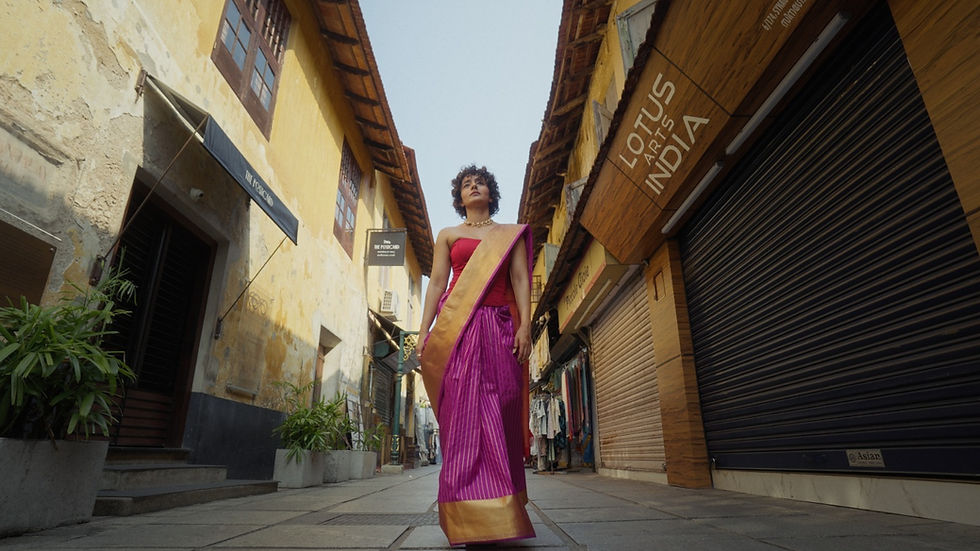
He falls for Mehr, who’s almost parrot-like. Chirpy, angry, dressed in those colours. And in mythology, the parrot is tied to Kamadeva. So I thought that parallel is too good to ignore. There’s shapeshifting, there’s revelation, there’s a cliffhanger. And the rest unfolds in the coming music videos. But at its core, the song is about something very human: being afraid to fall in love. Because love means effort, vulnerability, pain. And when you’ve lived a little, you become reluctant. Even when you’re drawn to someone, there’s fear.

For a Gandharva, that fear is even bigger. The stakes are higher. But the feeling is the same. The song is about surrendering anyway. There’s a line, if it’s meant to happen, I’ll let go of my anxiety and let it happen. Like, what agency do I even have at that point? So yeah, Gandharva says “Amen” for some reason. (laughs)
AN: I’m really drawn to your on-screen presence. The character has this quiet cockiness, like he knows exactly what he’s doing but is also having fun with it. When did you arrive at that DNA? Was it intentional, or just you bleeding into the character?
AKS: It’s both.
I can only write from what I’ve experienced. That’s my limitation, and maybe my strength. Manmadan is basically me, just with higher stakes. Fantastical stakes. If my life last year was turned into something mythological, that’s what it would look like. But I also borrow from characters I love. Playful, mischievous figures, jinn-like characters, like Luttapi. I absorb those traits into my real life. I start behaving like them. I’m a jester. I’m always doing bits, always annoying people. That’s just who I am. So when I write, it’s not like I’m inventing something new. I’m just exaggerating what already exists.
For other characters, I pull from real people. Maahir, for instance, I met him for like an hour and a half at a friend’s place. And months later, I wrote a character with his name. I could see how he’d behave, his gait, his energy, that mix of anger and sweetness.

Same with my partner. That’s where the emotional blueprint comes from. Casting was crucial. I needed people who already had those values and energies. That’s how I found Swetha. I didn’t have to direct her much. She just had to be herself. It’s just my friends and me. We sit, refine characters, build the narrative, tweak intensity, make it more watchable, more intimate. It’s very organic.
AN: What’s next for Manmadan? What should people look forward to?
AKS: The songs will have different titles, but they all come under one EP, Manmadan. It’s about six or seven tracks, a full storyline. Everything’s planned out till March 2027. For now, till August, expect music, then the visuals, and eventually everything will come together for people to piece the story. Hopefully, I tell it well enough for it to land (laughs)



Comments