
Small Town, Big Love, Little Homes
Sharing little pieces of belonging, memory and mother-tongued love with The Kayal Magazine — When Chai Met Toast tells us about small town, big love and little homes.
Small town

Small towns that carry soda narengya (Lemon soda), kaplandi mittai (peanut fudge), little children on their bicycles, swaying coconut trees, ammuma’s (grandma) stories, light blue milma milk packets stacked like fish on freshly printed Mathrubhumi (newspaper), peacock feathers treasured in books — a whole world folded tightly enough to wander through with bare feet and wonder.
For Ashwin, it’s the spice of fish, the anticipation of fresh, flawless, flaky parotta drizzled with beef chaar (curry) “Trivandrum, I remember, my sister, my dad, and I used to go for a swim in a pool every weekend. And on our way back, there was this restaurant called Ambalapad. Just going out to eat porotta and beef, or dosa and chammanthi, made my day. Or Sundays at Hotel Highland for their fish curry meals, a routine that never leaves us unenthused. It's a shared core memory”.
For Palee, it’s his everyday, mundane walks in the island city, little ice cream pit stops and the Marine Drive sea breeze with his family.
“Actually, three of us, Achyuth, Palee, and I (Pai) live close by in Kochi. So there have always been pockets of local attractions that we used to cycle to, later take our scooters to (chuckles). So while it’s in the middle of the city, it felt like a small town.”
Big Love
Little morning snuggles shared with Isaiah, hops and hide and seek with little big cats - Ollie and Loaf, Igyah’s enna thala (hair oil) massage and Nanamma’s Star Fruit Dry Pickle
“I remember having these after-school lessons with my mum. She used to help and teach me Hindi. This was early primary school. Notebooks open, Hindi alphabets repeated aloud, conversations folding into a secret tongue of our own. Half Malayalam -sentences, Tamil rhythms, English fillers. Between adhyapika and affection, Amma became Igyah, says Achyuth. Some evenings, smelled of warm coconut oil, Igyah seated behind me for an enna thala (hair oil) massage. With slippery parachute hair, oil-slick hands, our hearts felt full.
For Pai, love often arrived in a steel plate from the kitchen, with recipes as old as the big tree in the backyard. The food Nanamma (grandmother) and Ammal’s (mother) made — a pinch of this and a pinch of that. Only now, being a fitness enthusiast, when he chats with ChatGPT, the replies come back calling them “superfoods”. So is the story of Nanamma’s Star fruit dry pickle and Bamboo shoot sabji. Tangy, sharp and deeply addictive. “I used to hate it back then,” he laughs, “and now we literally fight over the last bit of it.”
As for Palee, even before the final song fades out, there’s already one thought waiting at the edge of the stage: how soon can I get back? It’s become an inside joke around him now. The minute the performance ends, he’s already calling the tour manager, checking flight timings, and asking if everything’s on schedule. “I might miss the flight from Kochi to the show,” he laughs, “but I’ll never miss the flight back home.”
Though it’s the small rituals for Ashwin. Little packets of treats for Ollie and Loaf sitting at the door. “Cats,” he says, laughing, “probably think if you disappear for too long, you’ve either escaped or been kidnapped.” But if you come back carrying something, you’re forgiven instantly. A hunter returning home. So every trip back ends the same way: Big hugs, treats opened, tiny paws circling.
Little Homes
For the longest brief moment, the only world we knew was home. Yellow lights spilling over study tables, hot steaming cups of Bournvita and chaya. Racing back home on bicycles to racing back in flights today. Hands of love dolled up in Pond's cold cream, peeling ripe oranges on a balmy day. Television sounds drifting through half-open rooms — in the language of remembering, home is where we return to, no matter how far we go.
“In our house, love has always moved through the kitchen first. Everyone cooks. Everyone feeds,” says Ashwin. “I remember waking up to my father already in the kitchen at dawn — coffee brewing, vegetables chopped and kept ready for Amma to begin the rest of the cooking”. However, his favourites are Amma’s phulka, Chicken curry and Russian salad. “It’s a combination only found at my place,” he laughs. “My mom makes the best phulkas. Insane, actually.” Some afternoons, the two of them would sink into a couch, watching gloriously overdramatic Telugu films neither of them would ever seriously defend, except his mother loves Mahesh Babu with complete sincerity. “She’s the most beautiful person on planet Earth and a true fighter, you know”, he says. For over two decades now, she has lived with Trigeminal Neuralgia. A severe nerve condition that makes even ordinary things painful. Cold weather, ice cream, and sometimes even eating itself. “I call her Ammuse,” he smiles. “And she has this smile… if she smiles at you once, the whole room would light up.”
For Achyuth, home looks a lot like Igyah waiting for me at the doorstep. “No matter what hour the tour ends or how late the flight lands, she stays awake until I return. Just seeing her eyes happy makes me happy,” he says. The heart of the house is a swing in the living room. At seven every morning, hot, steamy chai in hand, the three of them — him, Igyah, and his father gather there before the day scatters everyone in different directions. “In the gentle creak of that swing, between morning chai and half-finished sentences, we find each other again every single day.”
Unlike the others, home for Pai has always been full — grandparents, parents, a sister, generations moving around each other under one roof for almost all of his life. “If I’ve been away for a week,” he says, laughing, “I already know there’ll be a lot waiting for me to do at home.” And strangely, that is what he looks forward to most. Everyday banalities of life. Small chores. Cleaning together. Rearranging things, helping Aabu (grandfather) fix something.
Palee ties home to the rediscovery of his mother. “I understand her now,” he says. “Back then, during school days, Amma was very strict.” Three boys, endless chaos, a house that moved to the sound of rules, rulers and routines. “After seventeen years, I got a completely different version of my mother. She’s the first person I call today,” he says. And when she’s truly happy, her smile changes completely. “Everyone used to say my teeth stuck out during school,” he laughs, “that comes from my mom.” To him, hers remains the most beautiful smile he has ever known.
Draped in home
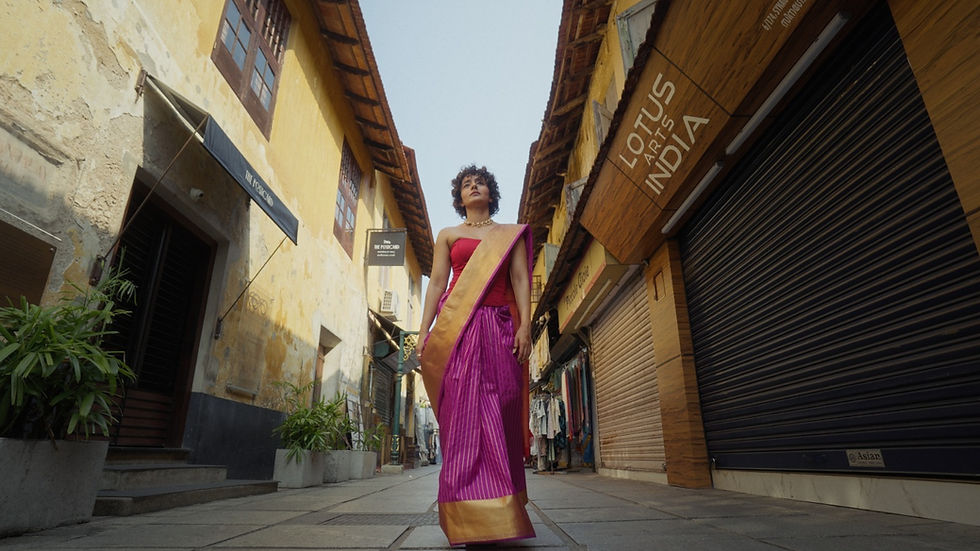
Finding a memory folded into the cupboards, tucked between the naphthalene, smelling like incense and time. Kasavu borders worn during Onam mornings, soft perfumes lingering after weddings, wet hair, gold jewellery, mullapoo sitting on the dressing table. A memory that is and feels like home. Amma’s Saree.
So when the idea came to turn their mothers’ sarees into stagewear, it felt like homecoming. “What better thing to carry onstage than home itself?” The sarees they chose were old, some nearly twenty years worn, loved, and preserved. Mothers agreed happily at first, until scissors entered the conversation. “Once it’s cut, it’s cut,” they laughed nervously. Still, they gave them away.
The final pieces drew from Panchavarna — the colours of Kerala. Blacks edged with golden kasavu, royal reds, greens, yellows, and checked patterns stitched into collars and sleeves, WCMT (When Chai Met Toast) now wear across cities and stages. The spirits were high, and so was the silk’s demand for care. Panic washed over us. Dry cleaning became serious business. “We machine-washed two of them once,” they confess, laughing guiltily. “Our mothers still don’t know.”
But the transformation brought unexpected tenderness, a love language, and an afterthought of the quiet labour their mothers carried all these years. Perhaps that is what home really is: something that continues wrapping itself around you, even after you leave it behind.
Written by Athira Nair
India's highest-streamed English band, When Chai Met Toast (WCMT), is endeared for their songwriting drawing upon heartwarming themes, multilingual lyrics and sing-along choruses. Often incorporating folk instruments like the banjo in a pop context, their music can be described as an Indian version of Mumford and Sons meeting Coldplay. Having headlined most major music festivals in the country, and with a growing international listener base.
When Chai Met Toast consists of vocalist Ashwin Gopakumar, guitarist Achyuth Jaigopal, keyboard player Palee Francis and drummer Pai Sailesh.


Comments