
Zevar
Updated: Mar 6, 2025
I. Manjula (maa)
“You're just too careless, Chotu," Manjula chided.
Her voice is tinged with equal parts assertiveness and concern, as I lost yet another gold earring amidst the fervour of a basketball game. Annoyed at what has become a frequent occurrence in her life, my spirited eleven-year-old questioned the necessity of wearing gold earrings for the first time in her life.
"I never asked for these in the first place. Why do you keep making me wear them when I can just wear the artificial ones?,” I revolted.
A girl who enjoyed her time at the basketball court more than doing whatever was expected of girls in small towns of northern India was at loggerheads with her mother whose fondness for jewellery knew no bounds. Frustrated with this constant source of anxiety in my life, I made a bold decision - to forsake jewellery altogether- a more practical and economical choice.

For Manjula, her jewellery is her gateway to her past and a way to forge her identity in the heart of her present. Manjula loves her jewellery like one loves old friends, their presence comforting and familiar. She hoards jewellery as if in an attempt to stow time. While Manjula was annoyed at my recurrent loss of her precious gold earrings, she was also hopeful. Perhaps Manjula sensed that my rebellion against jewellery was more than a practical decision; it was a small act of defiance, a step towards carving my own path. Perhaps she had done the same with her mother. In this tug-of-war between mother and daughter, each earring lost and each choice made carried echoes of a deeper narrative—one of identity, independence, and the evolution of familial bonds.
II. Uma (My naani)
In the tender glow of morning light, amidst the bustling studios, Uma began her ritual with a refreshing bath. Stepping into the fragrant waters, she washed away the weariness of the night, the running water echoing off the tiled walls as she thought about her next big upcoming project where she is playing the love interest of her favourite actor ‘Dilip Kumar’. Emerging from the soothing embrace of the bath, she moved on to the next phase of her ritual: selecting the perfect ensemble. Draped in yards of luxurious silk and chiffon, she swayed gracefully as she sifted through a kaleidoscope of colours and textures, each garment whispering tales of romance and drama. With her outfit chosen, attention turned to the delicate art of accessorising. Stunning pieces of jewellery adorned her slender neck, wrists, and ears.

Each piece is a testament to the opulence of an erstwhile era, adding an extra dimension to her already enchanting presence. With a final touch of rouge to her lips and a sweep of kohl to her eyes, her ritual was complete. With her hair styled in intricate waves and curls and big buns, adorned with flowers and jewels, she was ready to step into the spotlight and mesmerise audiences with her timeless beauty. As the cameras began to roll, capturing her every move in shades of black and white, she transported viewers to a world where elegance reigned supreme and dreams knew no bounds until interrupted by the scream of bablu, the youngest of her four kids. All of Uma’s dreams stood shattered as she had to step out of her chamber to tend to the realities of her life.
Married at the age of eighteen to a handsome and educated man, spoiled rotten by her nine elder brothers, a movie star except she wasn’t one. For the lack of a better word, Uma, my naani, was a diva who was stuck in a life far too ordinary compared to her extraordinary self.

Uma’s love for jewellery mirrored her complex persona—bold, possessive, and unapologetic. Which is why when she handed a pair of her silver jhumkas to me for a dance performance in school, I was equal parts surprised and ecstatic. Inevitably, life's tragedies reshaped Uma's world. Losing her eldest son to a tragic accident and gradually succumbing to memory loss- Uma slowly faded into time like her portraits - bleached at the edges.
Memory too, like jewellery, is delicate.
Sometimes, I wonder if she might have remembered me at all during the last few years of her life. Her jhumkas are the only tangible links left to her memory. They have survived much displacement with my constant moving around, have seen many lovers come and go, have been forgotten in boxes and on shelves but have always managed to find me every single time. Maybe, that’s how Uma remembered me too. In liminality.
III. Girija (My daadi)

‘When is the school trip coming up?’ Girija, who I loving]y called Ajjo, inquired as my thirteen-year-old self sobbed into her collarbones after a disappointing Maths exam. Overwhelmed with guilt and reluctance, I said, ‘Shimla, but I am not going anywhere’.
Ajjo's response was unexpected—she cackled softly and insisted, "Of course, you are going."
With a firm yet gentle hand, she pressed three thousand rupees into my trembling hands, an act of generosity that defied her usual prudence with money.
Girija was the eldest of seven kids and was married off young, as happened in those days, usually to rich or royal families with little importance given to the groom’s individual qualities or earning capacity. Girija was married off to this facade of a royal family. Funnily, this era is called the ‘Golden Age’ in my family's lore. It is when my dad's forefathers reigned as kings and rulers. Though much of this splendour has faded into the mists of time, fragments of it linger on in the form of old and worn remains of what was once an influential palace in the Pratapgarh district of Uttar Pradesh. Also, the muhars (gold coins adorned with Urdu inscriptions used as currency during the reign of kings). Girija managed to salvage fourteen of them after selling a lot of her jewellery and heirlooms to keep the food for her five kids on the table and tend to her husband’s long spell of illness. Girija's relationship with gold jewellery was, to say the least, ‘complex’.
Ironically, the first time I found myself stumped and dumbfounded by jewellery was when I saw a photograph of her from her wedding day as a child. Picture this: butterflies bedazzled kamarband with semi-precious gemstones fluttering around a thirteen-year-old Girija, draped in her resplendent 'Banarasi' saree on her wedding day. It was the stuff of fairytales, I tell you!
A couple of inches shy of five feet, Girija could easily be dismissed as an ordinary woman next door. Much to everyone’s surprise, she navigated the complexities of family life, agriculture, and spirituality with a grace that belied her petite frame. However, her true passion lay beyond the confines of her responsibilities. Girija harboured a raging desire to travel the world, all by herself.
After bidding adieu to Baba, fulfilling her familial duties and giving away all her material possessions, she embarked on the adventure of a lifetime. Where did she go, you ask? Well, for months on end, she disappeared like a ghost, leaving us to wonder of her whereabouts.
What accompanied her on this lifelong adventure were her pazeb and her tiny nath. Often when I missed Ajjo, I’d dream of her roaming about in her pazeb, tinkling through the bustling streets of Benaras with freedom braided in her jasmine-oiled hair and the glimmer of her nath casting an ethereal glow on her face under the moonlit skies of the mountains on the fringes of Rishikesh.

To my thirteen-year-old self, Girija was an enigma and the coolest person ever.
IV. Aishwarya
In the bustling heart of Delhi, amidst the ceaseless hum of city life, my twenty-nine-year-old self can be often found reconciling the insatiable lust to explore far-flung corners of the globe while maintaining financial stability and crafting a life that may not make sense to all. Quite often, fear lurks at me like shadows at dusk. On days when uncertainty looms large, I find solace in a precious keepsake—a shimmering pazeb.

The most tangible link of Girija’s legacy, an actual piece of her. I borrow it on days when I want to borrow her resilience. I slip the pazeb onto my ankle, as if borrowing a measure of Girija’s courage, hoping to channel that same unwavering spirit. The pazeb morphs into an anchor grounding me.
As the city pulsates like a monster, silently heaving, Uma’s oversized jhumkas break the deafening silence of my apartment.

The song of a million ghungroos enters every room before I do. I fix my hair, retouch my lipstick and check myself promptly in front of the mirror. Uma and Girija unite in my reflection, telling me - ‘you don’t have to do this alone. You’re never alone.’ And I walk into the world embodying exactly this.
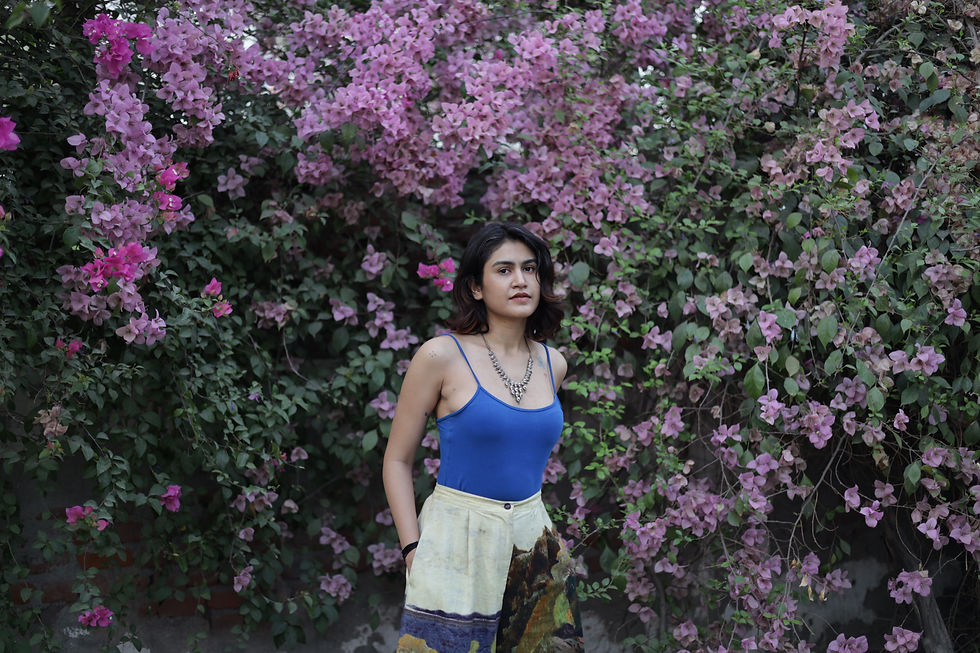
Today, the jewellery I had so vehemently rejected as a child has become a powerful metaphor for embracing my femininity. In a world often defined by its masculine energy, embracing the power of divine femininity is not just empowering; it’s an act of rebellion. Our Zevar is a pathway to reconnect with the innate strength, intuition and beauty of the feminine. It’s a celebration of the spirits of all the women who softened the edges of the world for women like me to live our truth unapologetically. To honour the wisdom of our bodies, the depths of our emotions, and the vastness of our intuition. My zevar, by extension, is my tribute, my talisman and perhaps, an apology to the spirits of all the women who came before me.
Maybe, even - my zevar is a second chance at memory.


Heirlooms carry stories that outlast us!
heritage, identity, resilience.